
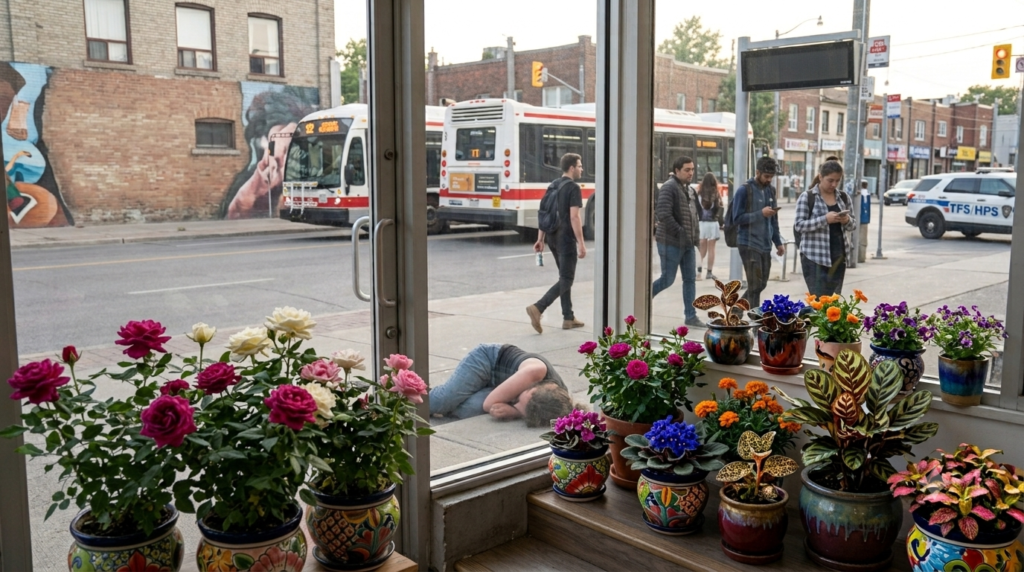
Public overdose exhaustion begins quietly on a sunny afternoon. A woman sits down on the bus stop bench directly in front of my convenience store window. Ten minutes later, she slumps over sideways. Half an hour after that, she has stretched out entirely onto the concrete sidewalk path, blocking the doorway entrance.
Cars drive past on the main road. Pedestrians step over her outstretched feet without missing a single beat. Whenever I share security footage or photos of scenes like this, the first question people ask is always the same: “Is she dead?”
No, she isn’t dead. If you run an independent retail store or live near an urban center, you already recognize this scenario. Welcome to the daily reality of public overdose exhaustion, where endless repetition has transformed public concern into overwhelming fatigue.
Understanding Public Overdose Exhaustion in Modern Cities
Years ago, severe drug use was hidden away in quiet alleyways or behind closed doors. Today, open-air addiction happens in broad daylight—outside neighborhood churches, beside local school boards, on bus stop benches, and directly across business doorways.
It is easy for outsiders to claim that urban communities have simply lost their humanity. However, public overdose exhaustion is not caused by a sudden lack of empathy; it is born from pure compassion burnout.
When you call emergency services to report a suspected incident, dispatchers do not simply take the location and send help. Instead, they walk you through a lengthy procedural questionnaire:
- Is the person breathing?
- How old do they appear to be?
- Can you physically approach them to check for a response?
For a small business owner working a 12-hour shift alone, stepping outside to wake or touch an unpredictable individual under the influence poses real safety risks. You face potential aggression, verbal abuse, or exposure to hazardous substances. Furthermore, emergency personnel are repeatedly dispatched for individuals who are simply sleeping off a heavy trip, straining public medical resources while urgent emergencies wait in line.
A Four-Hour Nap on the Concrete Walkway
On this particular afternoon, the woman lying on the walkway stayed passed out for four solid hours. Customers stepping into the store casually glanced down and asked, “Is she going to be okay?”
My response was straightforward: “She took drugs, got tired, and is sleeping it off.”
Eventually, her boyfriend walked up to the scene. He tried shaking her shoulder to wake her up. When she did not move, he did not panic or call for help—he simply sat down on the curb next to her and waited. Around 6:00 PM, she finally woke up, screamed at him for disturbing her sleep, and stumbled down the street.
Dealing with these daily disruptions makes it challenging to maintain focus on personal growth and staying grounded. Just like learning to handle store stress in our post on finding resilience in unexpected moments, business owners must build mental boundaries simply to survive the workday.
Why Local Businesses Are Reaching Their Limit
We are constantly told that society needs more empathy, but human sympathy is a finite resource. When shopkeepers encounter public overdose exhaustion every single day, initial shock degrades into irritation, and concern turns into complete emotional detachment.
No business owner wants to see public sidewalks converted into makeshift bedrooms. We want vibrant, safe streets for families, customers, and neighbors. For more real-life observations from behind the counter, you can read my complete collection in The Convenience Store Diaries Volume 2 on Amazon.
Until systemic solutions address the root causes of street-level addiction, local store owners are left with only one choice: step around the chaos, protect their livelihood, and keep their doors open.