
For years, I’ve dedicated my life to studying clean labels to protect the body from toxins. But running a convenience store in Hamilton teaches you that the most lethal poisons don’t come in a package. They don’t have a chemical label. Sometimes, the most dangerous toxicity hides inside a psychological pattern I call love-blindness.
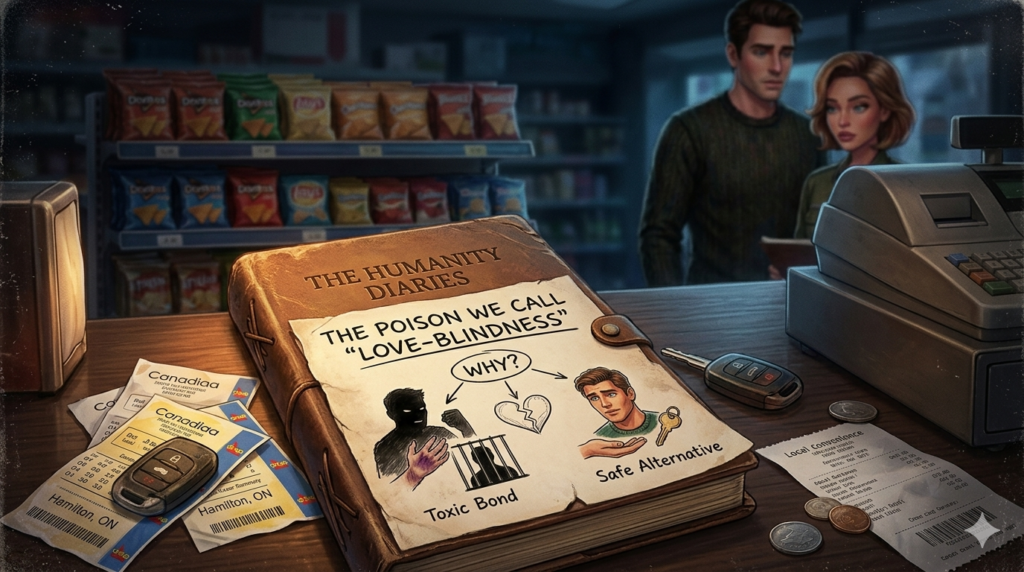
As a life detective, I’ve learned to watch the subtle ingredients of human behavior at my cash register. And last month, a 25-year-old regular customer showed me a case of extreme love-blindness—or what psychologists call a toxic trauma bond—that left me completely stunned.
The Toxic Ingredient: A Cycle of Abuse
She is young, only 25, an age where life should be full of discovery. But every time she walked into my store with her ex-boyfriend, the atmosphere turned heavy. He was a known local drug dealer, a man who carried chaos wherever he went. Their relationship was a constant battleground. He would yell at her right in front of the counter, humiliating her, and forcing her to pay for every single item he wanted. She would hand over her hard-earned money without a single word of complaint.
Soon, the warning labels became physical. I started noticing bruises on her face, her arms, and her forehead. When I gently asked her about it, she openly admitted they fought all the time.
Then, two weeks later, the man vanished. When she came into the store alone, I asked her where he was. With a calm, almost serene smile, she looked at me and said, “He is in jail.”
I looked at this young girl, free from her abuser, and asked, “Are you going to move on now? Are you still waiting for him?”
Without hesitation, she replied, “Yes. I still love him. I’m waiting for him to come back.”
The Safe Alternative to Love-Blindness
Human psychology is a strange thing. While she was waiting for a man who used her as a punching bag, another ingredient entered her life. A longtime male friend had been quietly in love with her for years. With the drug dealer in prison, this new man stepped up. He treated her like absolute royalty. He took her out for dinners, invited her on hiking trips, traveled with her, and tried to heal her wounds.
Eventually, he convinced her to rent an apartment together as roommates. He thought his pure devotion would finally cure her love-blindness.
But you cannot force a person to read the warning label on a toxic relationship.
The Heartbreaking Choice
A few days ago, the new man walked into my convenience store. The joy was completely gone from his eyes; he looked entirely broken. He leaned over the counter and confided in me. She was pregnant with his baby. But instead of celebrating, she had just taken medication to terminate the pregnancy at two months.
He had begged her on his knees to let the baby be born. He promised to provide everything. But her reasoning was cold and absolute: “I don’t love you. I am still in love with my ex, and I am saving myself for him when he gets out of jail.”
What breaks my heart as an observer is the sheer contrast. She fiercely protects the memory of a man who treated her like trash, while completely rejecting a man who treats her like a princess. Today, they still live together. She refuses to admit he is her boyfriend, yet he refuses to give up on her, cooking and cleaning for her every day, whispering, “One day, she will be my wife.”
Looking Closer Beneath the Surface
This isn’t just a story about a naive girl; it’s a reflection on human nature. Why do our brains sometimes reject the clean, nourishing love we deserve, and instead crave the toxic patterns that destroy us?
The ex-boyfriend is still behind bars, the present man is still pursuing a shadow, and the girl is still waiting. This is only Episode 1 of her story. When those prison doors finally open, what will happen to this fragile household? Only time will tell.
Until then, let’s look closer at the people around us. Sometimes, the most dangerous toxins aren’t what people are eating—it’s the relationships they are letting consume them.
If you would like to read more about the diary, you can check out my previous entry, [The True Story of Kate], where we look closer at the hidden warning labels of isolation in our neighborhood.