
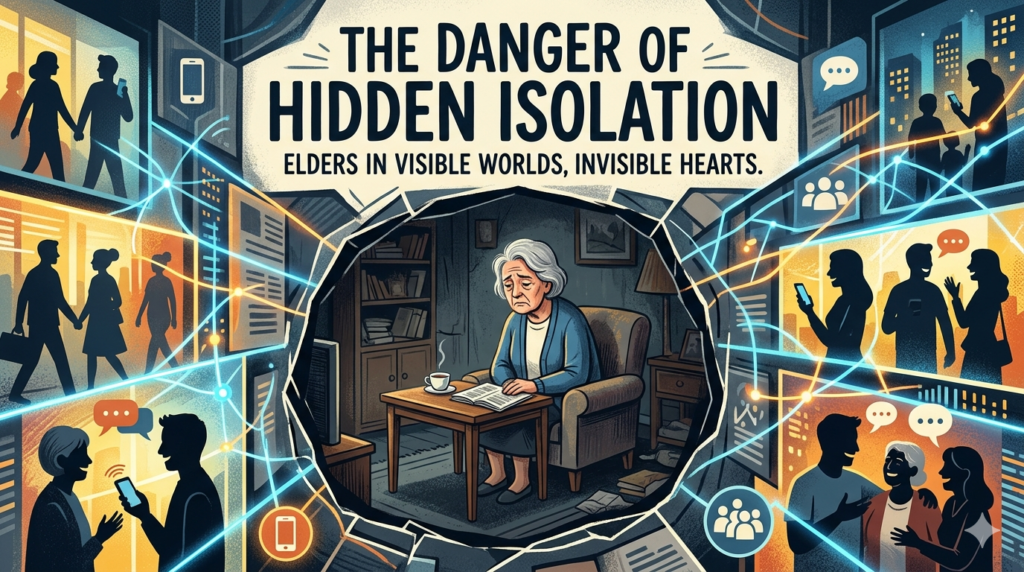
In my years analyzing food labels for synthetic additives and heavy metals, I have come to realize a sobering truth: the most lethal poison in modern society doesn’t come from a manufacturing plant. It has no chemical formula, no smell, and leaves no physical trace on a nutrition panel. This invisible toxin is hidden isolation.
As a store owner, my counter serves as a unique window into human behavior. We see the faces people choose to show the world, but we rarely see what happens when they close their doors at night. For a long time, an amazing 75-year-old woman named Kate came into my store every single day, completely lighting up the room. She would greet me with a massive, vibrant smile and say, “Angie, give me the winning lottery ticket today!” I would always laugh and hand it over, replying, “For sure, Kate, this is definitely the one!” Kate was a living angel in our neighborhood. Even though she lived entirely by herself and lived a very modest, simple life, her heart was infinitely wealthy.
She regularly bought extra snacks from my counter just to walk outside and hand them directly to homeless individuals or stray dogs sitting on the street corner. When I told her how incredibly kind she was, she would just offer a modest smile and say, “People need help, Angie.” Then, about a month ago, the physical toll of her quiet life began to show. She started complaining of severe back pain. Her steady pace slowed down to a crawl, and she began relying heavily on a metal walker to get around. Yet, despite the obvious physical agony, her spirit never bent, and she refused to stop coming to the store.
She was bursting with anticipation because her sister’s daughter was getting married soon. Kate had never married and never had any children of her own, which was why she poured an ocean of love into this niece. She treated her exactly like her own daughter, spending months planning ahead and buying a gorgeous, expensive dress for the special day. Seeing how much she was struggling to stand straight, I felt a deep sense of worry. I asked her, “Are you sure you shouldn’t see a doctor to check your back before traveling for the wedding?” She shook her head fiercely and looked me in the eyes: “No matter what, I am going to that wedding.”
A few days after the event, she proudly returned to the store and showed me the beautiful wedding photos on her phone. She was absolutely glowing in her nice dress, surrounded by family. It was the happiest I had ever seen her.
But after that joyful day, a sudden silence fell. Two weeks passed, and her usual spot at my counter remained completely empty. I kept questioning myself, hoping she was just taking a well-deserved vacation. Then, one of her neighbors walked through my doors. When I asked if he had seen Kate lately, his face went completely blank. He whispered, “Kate passed away. They found her in her apartment.”
Because she lived in total, hidden isolation and fiercely guarded her independence, nobody knew she was in a medical crisis. Her sister had been calling her phone for two days straight with no answer before finally asking the police to conduct a wellness check. By the time they opened the door, Kate had been gone for two days.
Kate spent her life wrapping her intense pain in a beautiful smile so she wouldn’t burden a single soul. Her tragedy reminds us that hidden isolation is a quiet epidemic. Please, check on your elderly neighbors and the people in your life who always seem strong. Sometimes, a simple phone call is the only lifeline they have left.
To read more true stories from my counter, explore the full collection of the Humanity Detective Diaries.